Image:Asian Development Bank
The Asian Development Bank (ADB) has announced it will provide transaction advisory services for five additional solar and battery energy storage projects in Bangladesh. Following this expansion, the programme covers six solar-storage projects in total with a combined capacity exceeding 1GW, designed to draw substantial private-sector investment and advance Bangladesh’s energy transition goals.
Built upon ADB’s ongoing advisory support for the 130MW Sonagazi solar PV project in Feni District, which includes a 26MWh battery energy storage system (BESS), the overall programme will be implemented in three phases. Sonagazi forms Phase 1, while the five newly-added projects fall under Phase 2 and Phase 3. The tender for the Sonagazi project is expected to be launched within 2026. As the first project under the agreement, it will establish the framework for structuring and procuring the remaining five projects.
A core objective of ADB’s advisory work is to mobilise more than USD 1 billion in private sector investment, supporting Bangladesh’s renewable energy targets: generating at least 20% of its electricity from renewable sources by 2030, rising to 30% by 2040.
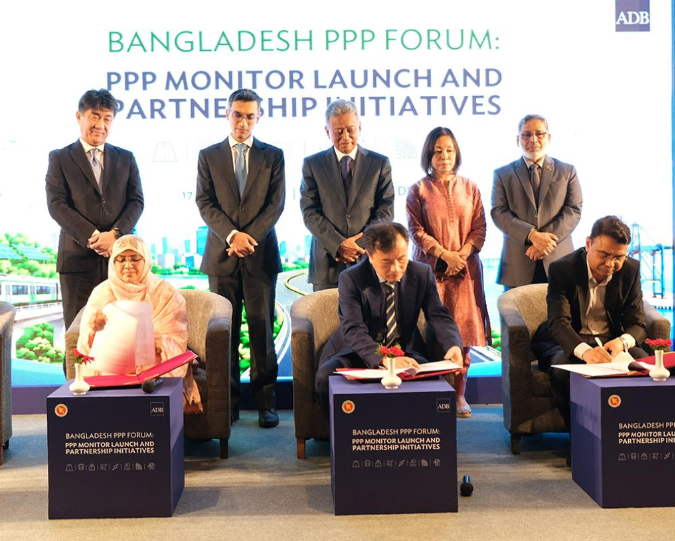
Under the terms of the signed memorandum of understanding, ADB will support Invest Bangladesh and the Bangladesh Power Development Board (BPDB) in assessing the suitability of government owned land parcels for the additional projects. The scope of advisory services includes project preparation, technical and financial assessments, market sounding, tender document preparation, and support for competitive bidding and contract awards.
Statistics from the National Database of Renewable Energy (NDRE), managed by the Sustainable and Renewable Energy Development Authority (SREDA), show that as of 1 November 2026, Bangladesh’s installed solar capacity stood at 1,661.32MW, comprising 1,283.75MW of on-grid and 377.57MW of off-grid capacity. Solar accounted for around 85% of the country’s total renewable installed capacity of 1,954.42MW. Bangladesh is targeting 5,500MW of rooftop-solar capacity across approximately 870,000 rooftops by 2030, with a targeted 20:80 split between domestic and international financing.
An August 2026 report from the Institute for Energy Economics and Financial Analysis (IEEFA) found that rooftop solar in Bangladesh could save consumers up to USD 0.061 per kWh compared with grid electricity, with operational rooftop-solar capacity estimated at 667MW.
Meanwhile, ADB continues to leverage project financing and private sector investment to support renewable energy development across Asia and the Pacific. In July 2026, ADB approved a USD 850 million loan for the second phase of India’s residential rooftop-solar programme, following a USD 650 million loan approved the previous year for Phase 1. In the same month, ADB joined the World Bank Group, the Japan International Cooperation Agency (JICA) and the Government of Canada in reaching financial close on Timor-Leste’s first utility scale solar plus storage project, comprising 73.7MW of PV and 80.2MWh of battery storage. ADB also approved a USD 160 million loan to support at least 310MW of new solar capacity in Bhutan. Back in May 2026, ADB signed a transaction-advisory-services agreement with the Solomon Islands Electricity Authority to develop the country’s first large-scale grid-connected solar PV project in Honiara through private sector investment.