Global electric vehicle battery consumption reached 725.2 GWh in the first seven months of 2026, a year-on-year increase of 20.4%, according to the latest data from South Korean market tracker SNE Research. July alone saw battery installations hit 116.0 GWh, rising 22.1% from the same period last year.
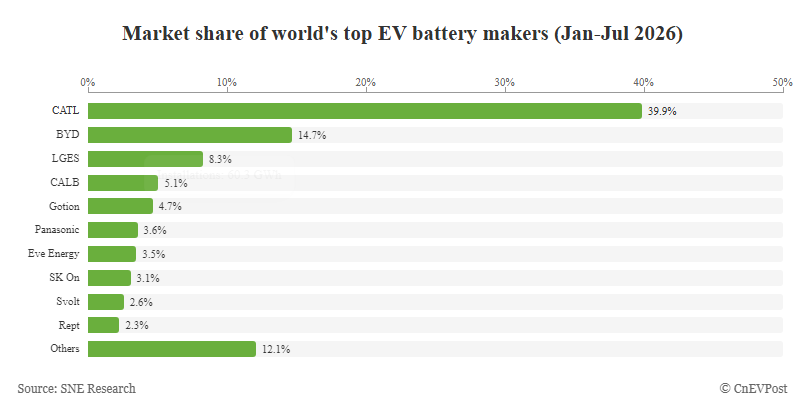
Seven Chinese suppliers occupied positions in the global top 10 EV battery makers, capturing a combined 72.8% market share, up 3.1 percentage points year over year. CATL and BYD remained the top two players, jointly accounting for 54.6% of global installations.
CATL kept its global No.1 ranking with 289.6 GWh of battery deployments in January-July, marking a 26.6% year-on-year growth. Its market share climbed to 39.9%, approaching the 40% threshold and flat from the January-June reading. BYD came second at 106.7 GWh, with a modest 4.7% annual growth and its market share dipping to 14.7%.
LG Energy Solution took third place with 60.3 GWh, up 4.5% year-on-year. SNE Research noted LGES continues to supply Tesla, Hyundai Motor Group, GM and Volkswagen, yet its growth lagged the overall market.
Chinese battery firms delivered strong growth: CALB ranked fourth with 37.3 GWh (+34.3% YoY), Gotion High-Tech fifth at 34.0 GWh (+44.2% YoY), EVE Energy seventh with 25.0 GWh (+53.1% YoY), and Svolt Energy ninth at 18.9 GWh (+39.1% YoY). Rept Battero Energy recorded a 118.5% surge in installations to 16.9 GWh, breaking into the global top 10 for the first time and displacing Sunwoda.
Panasonic secured sixth spot with 26.2 GWh (+7.6% YoY), supported by Tesla’s North American sales. SK On was the only top-10 player posting a decline, with installations falling 9.8% to 22.3 GWh.
Regional demand showed diverging trends. Europe saw battery installations rise 29.3% year-on-year, China registered 16.6% growth, other Asian markets jumped 77.1%, and South America soared 192.6%.
In contrast, North America witnessed a 20.2% drop. SNE attributed the North America slump to the expiration of federal EV tax incentives at the end of September last year, which pulled the share of battery electric vehicles in US new car sales down to roughly 6%.