Image:Huawei
Saudi Arabia’s Red Sea multi‑utility project has reached full commercial operation, delivering a large‑scale renewable‑driven off‑grid system to power an entire tourism hub and its supporting infrastructure.
SEPCOIII, a subsidiary of PowerChina and the project’s EPC contractor, announced the commercial‑operation milestone on August 21. The EPC contract was signed with ACWA Power in February 2021.
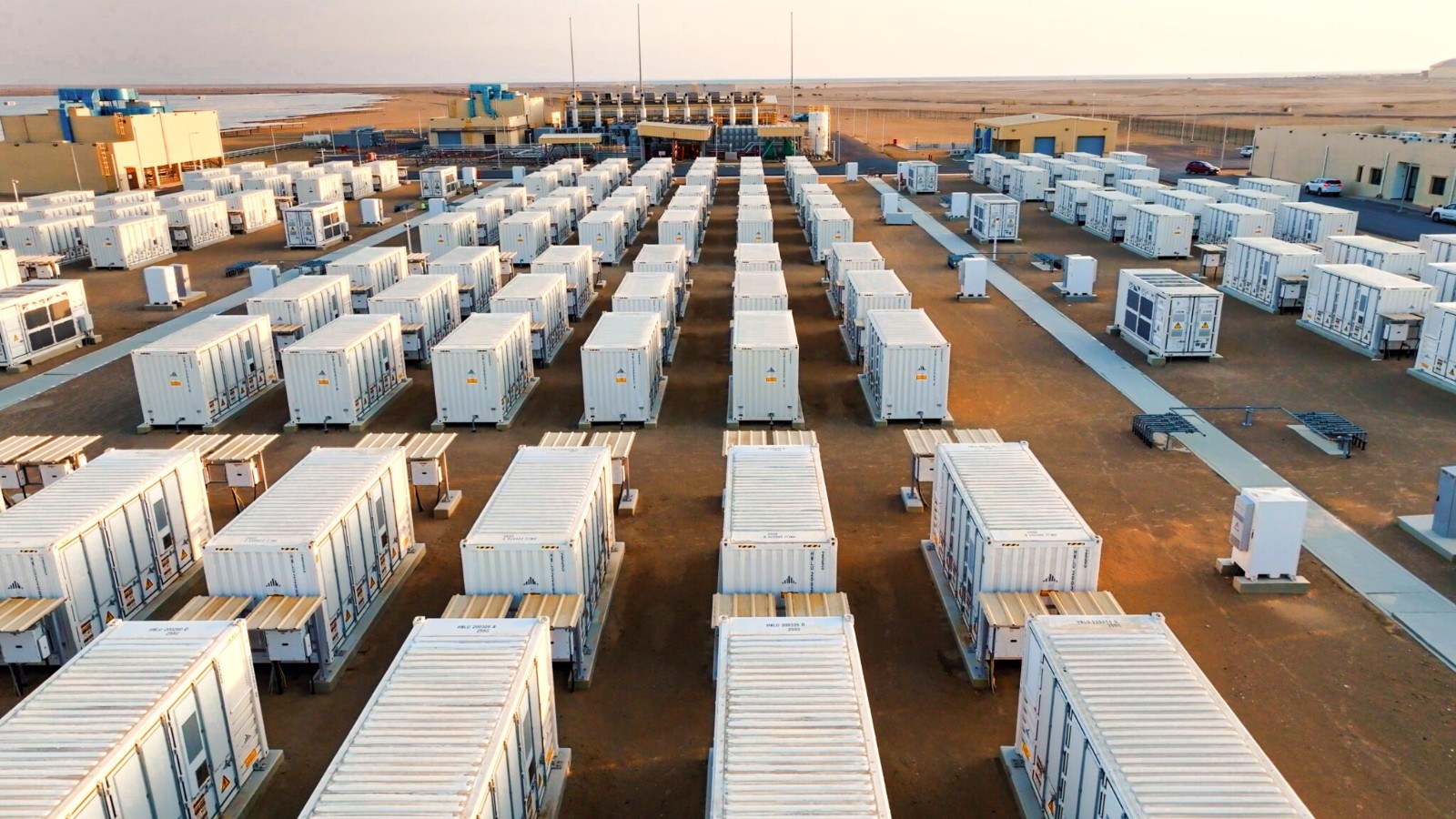
Built for Red Sea Global’s tourism site on Saudi Arabia’s west coast, the facility runs completely separate from the national power transmission grid. According to ACWA Power, the project features 358 MW of solar capacity, 1,225.4 MWh of battery energy storage and 112.5 MW backup internal‑combustion generation. Earlier documents cited figures of roughly 340 MW solar and 1.2 GWh storage. Huawei supplied PV inverters and the battery storage system for the project, quoting a scope of 400 MW solar and 1.3 GWh storage for its equipment package.
Operating within an isolated microgrid, the grid‑forming battery storage undertakes critical tasks beyond standard grid‑tied storage. It sets and stabilises grid voltage and frequency, balances fluctuating solar output against load demand, and delivers power when solar generation drops.
Operational records show the system has proven black‑start and fault‑ride‑through performance, creating a utility‑scale reference for grid‑forming storage in off‑grid conditions.
In May 2025, Guinness World Records certified 1,125.18 MWh of the battery installation as the world’s largest‑capacity off‑grid battery‑based energy storage facility. Construction kicked off in October 2021, and the battery unit went into service in September 2023.
More than a typical solar‑plus‑storage scheme, the multi‑utility microgrid integrates seawater desalination, potable water distribution, wastewater treatment, district cooling, solid‑waste management and communication infrastructure. ACWA Power’s data shows three reverse‑osmosis desalination plants with total daily output of 32,500 cubic metres, 16,000 cubic‑metre‑per‑day wastewater‑treatment capacity and 32,500 refrigeration tons of district‑cooling capacity.
he renewable‑energy‑powered complex serves active resorts, Red Sea International Airport airside facilities, staff accommodation, EV charging, 5G networks, district cooling and local water supplies.
The project is delivered under a 25‑year utility concession via a public‑private‑partnership framework. Instead of owning the utility assets, Red Sea Global procures power, water and other services from the project consortium, with Saudi Arabia’s Public Investment Fund (PIF) backing the long‑term offtake deal.
SEPCOIII completed overall EPC duties, with Huawei and PV‑module maker Longi among Chinese suppliers for the energy scope.
Full commercial operation signals completion of the complete multi‑utility complex. Solar and battery assets have been brought online in phases since 2023.
This project serves as a major real‑world case of solar plus grid‑forming batteries supporting an isolated microgrid, rather than feeding power into a national interconnected grid. Its practical experience can provide valuable technical and operational insights for comparable projects on islands, remote industrial locations and new‑build zones where expanding traditional power‑transmission infrastructure is impractical or uneconomical.