
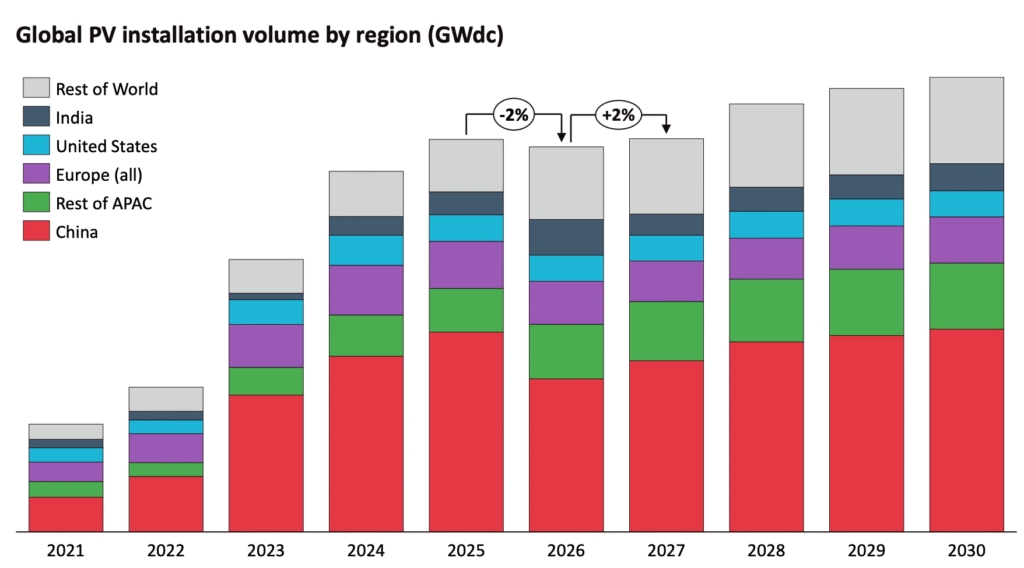
Global solar photovoltaic (PV) installations are projected to reach 638 GW in 2026, marking a year-on-year decline before resuming steady growth through 2030, according to the latest Q2 2026 industry reports from technical advisory firm Intertek CEA.
The market downturn in 2026 is exclusively driven by market stagnation in China, while most regions worldwide will maintain stable or accelerated PV installation growth, highlighting a clear regional divergence in the global solar market.
Intertek CEA’s PV Supply, Technology and Policy Report for Q2 2026 warns that the global solar supply chain faces severe and persistent structural oversupply, with manufacturing capacity at every production stage far exceeding 2026 market demand. Specifically, global polysilicon manufacturing capacity reaches approximately 2,034 GW, and module capacity stands at around 1,908 GW — creating a module supply surplus of over 1.2 TW against the 638 GW projected installation volume.
The firm’sPV Price Forecasting Report for Q2 2026 outlines distinct global PV price trends. Chinese module prices are set to rise from 2026 to 2027, as suppliers seek to expand profit margins and pass through rising material costs. U.S. module prices will remain elevated, pending policy clarity on tariff adjustments from the ongoing polysilicon Section 232 investigation. Meanwhile, Indian module prices will continue to be vulnerable to fluctuations in Chinese input costs throughout 2026 and 2027. A market price decline is expected from 2028 onwards, driven by industry maturity and stable yet low profit margins across the sector.