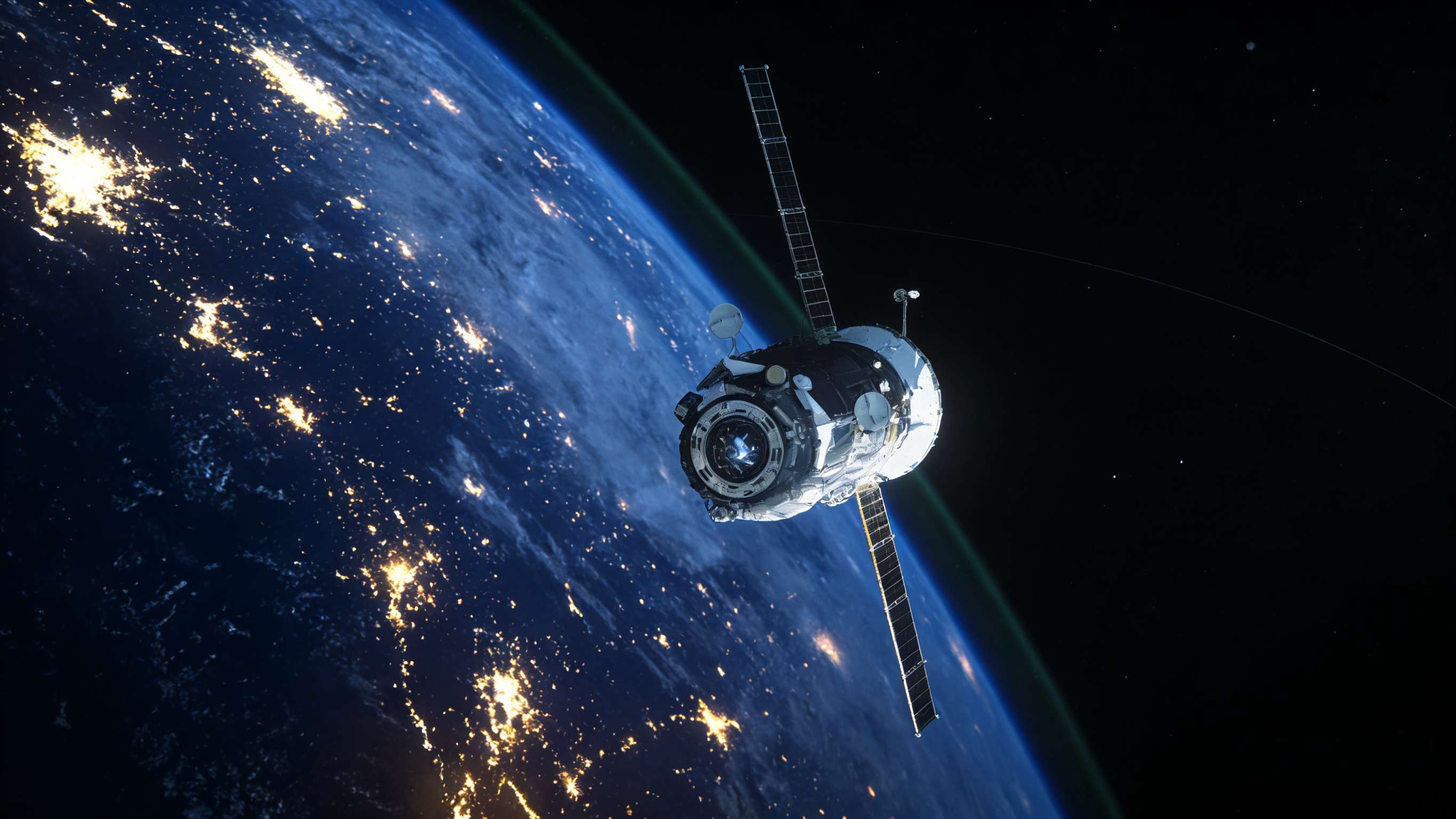
Greenland was not the only frontier market drawing attention at last week’s World Economic Forum (WEF) in Davos, Switzerland. Tesla CEO Elon Musk suggested that space-based solar power could soon become the most cost-effective way to run artificial intelligence, with full-scale deployment possible within two to three years.
Speaking with Larry Fink, interim WEF co-chair and CEO of BlackRock, Musk argued that solar energy collected in space is vastly more efficient than on Earth.
“When you have solar in space, you get five times more effectiveness—maybe even more—than solar on the ground,” Musk said. “It’s always sunny, so you don’t have a day-night cycle or seasonality or weather. You also get about 30% more power because there’s no atmospheric attenuation. The net effect is that any given solar panel will generate about five times more energy in space than on Earth.”
Cooling advantages in space
Beyond higher solar output, Musk highlighted thermal management as a key advantage for space-based AI infrastructure.
“It’s a no-brainer for building solar-powered AI data centers in space,” he said. “It’s also very cold in space. When you’re in the shadow, it’s about three degrees Kelvin. You can have solar panels facing the sun and a radiator pointed away from it, with no solar incidence—so it’s just cooling. It’s an extremely efficient cooling system.”
According to Musk, this combination of abundant energy and passive cooling could soon make space the lowest-cost location for AI computing.
“The net effect is that the lowest-cost place to put AI will be space, and that will be true within two to three years—three at the latest,” he said.
SpaceX and the cost of access to space
The feasibility of this vision depends heavily on launch economics, an area where Musk’s aerospace company SpaceX plays a central role. SpaceX is preparing for a potential record-setting public offering in 2026 and continues to focus on reducing what Musk calls the “cost of access to space.”
“Hopefully this year we’ll prove full reusability for Starship,” Musk said. “That would be a profound invention, because the cost of access to space would drop by a factor of 100. We think that would bring launch costs below the cost of air freight—easily under $100 per pound.”
Starship, the largest rocket ever built, is expected to serve as the primary vehicle for deploying solar-powered AI infrastructure in orbit.
From AI satellites to off-world infrastructure
Musk said the first step in this roadmap would be the deployment of solar-powered AI satellites, with more ambitious projects following.
“One of the things we’ll be doing with SpaceX within a few years is launching solar-powered AI satellites,” he said. “Space is really the source of immense power. You don’t need to take up any room on Earth—there’s so much room in space.”
Over the longer term, Musk suggested similar infrastructure could be built on the Moon and even Mars, particularly as AI-powered robots become capable of constructing and maintaining off-world assets.
Ultimately, Musk believes space-based solar could scale dramatically. “You could scale to hundreds of terawatts per year,” he said, pointing to a future where space becomes a central pillar of global energy and computing infrastructure.