Image:AFSIA
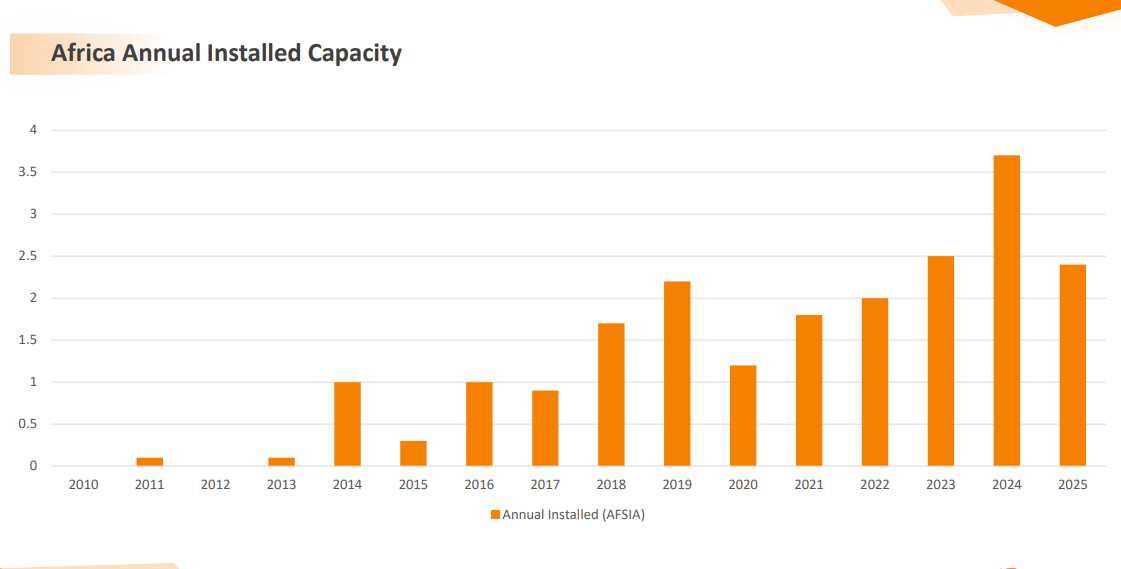
Africa installed at least 2.4 GW of new solar capacity in 2025, according to the Africa Solar Industry Association’s (AFSIA) Africa Solar Outlook 2026 report.
The figure is broadly in line with the 2.5 GW of solar deployments initially recorded for 2024 in AFSIA’s previous annual report. However, subsequent updates to AFSIA’s project database have identified an additional 1.2 GW of projects that came online in 2024, lifting last year’s total to 3.7 GW.
AFSIA’s project database now shows a cumulative operational solar capacity of 23.4 GW across Africa. The database currently tracks more than 42,000 projects, representing a 40% increase compared with the end of 2024. It includes projects at all stages of development with a combined capacity of 296 GW.
Despite steady growth in officially recorded capacity, AFSIA said solar deployment across Africa may be significantly underreported. Based on Chinese solar module export data, solar could already be up to 2.75 times more prevalent across the continent than official figures suggest.
According to the report, Africa’s total installed solar capacity could be as high as 63.9 GW. This estimate is derived from Chinese export data indicating that 58.1 GW of solar modules have been shipped to Africa since 2017, including 16.1 GW in 2024 alone, with a further 10% extrapolated to account for exports prior to 2017.
AFSIA added that when Chinese export data is taken into account, Africa was the world’s fastest-growing solar region in 2025, achieving a compound annual growth rate of 17%, compared with a global average of 2%.
In the report, AFSIA CEO John van Zuylen said the latest data challenges long-held perceptions that Africa is one of the least attractive solar markets, highlighting that the continent’s solar market share is far larger than previously understood.