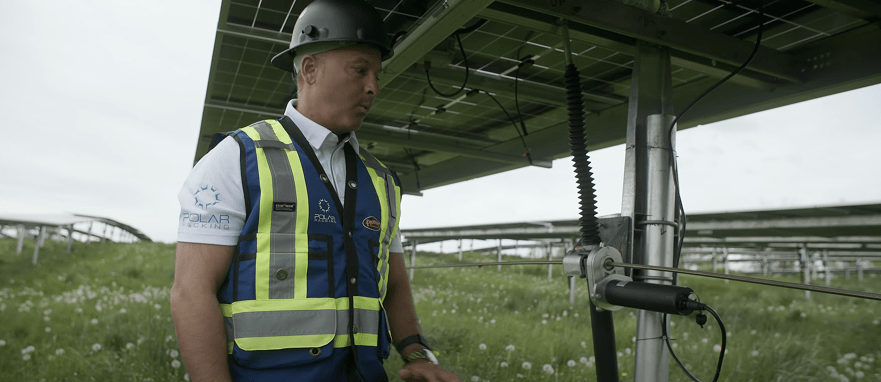
Image: Polar Racking
Canada-based solar mounting systems provider Polar Racking has entered the Australian market through its involvement in the 240MW Maryvale solar-plus-storage project in New South Wales, marking the company’s first project deployment in the country.
The Maryvale project is located around 12km northwest of Wellington within the Central West Renewable Energy Zone (REZ). It combines utility-scale solar generation with a 172MW/409MWh battery energy storage system (BESS).
The development is set to become one of Australia’s first large-scale DC-coupled solar and storage projects. Compared with traditional AC-coupled configurations, DC coupling offers several advantages, including higher system efficiency, lower equipment costs and greater flexibility in energy dispatch.
Polar Racking has supplied foundation solutions for the project’s utility-scale solar installation. PCL Construction has been appointed as the engineering, procurement and construction (EPC) contractor.
In addition, TrinaSolar will provide the solar PV modules, while battery systems will be supplied by Contemporary Amperex Technology (CATL). Spanish inverter manufacturer Ingeteam will also supply inverter equipment for the project.
Vishal Lala, founder and CEO of Polar Racking, described the Maryvale project as a strategic milestone in the company’s international expansion.
“This project marks our first step into the Australian market,” Lala said. “Foundations play a critical role in constructability and long-term performance, and we are pleased to support PCL Solar on this project. With global manufacturing and engineering capabilities, we can deliver a full range of solar mounting solutions worldwide.”
The Maryvale project will include the installation of up to 400,000 solar modules mounted on single-axis trackers across approximately 350–360 hectares. The project will have a grid export capacity of 172MW and is expected to generate around 521.25 million kWh of electricity annually.